
Os marcadores de posição permitem que uma mensagem alcance cada prospecto com seu próprio nome ou empresa. Você escreve {firstName} uma vez, e cada pessoa recebe seu nome real no momento do envio. Quais marcadores funcionam depende do modo de mensagem escolhido.
Quais marcadores funcionam em cada modo?
| Marcador | Human Writer | Redator IA |
|---|---|---|
{firstName} | ✅ Substituído | ✅ Usado pela IA |
{lastName} | ✅ Substituído | ✅ Usado pela IA |
{company} | ❌ Não disponível | ✅ IA seleciona o correto |
{adaptive_url} (e aliases) | ✅ Substituído | ✅ Substituído |
{{col.NomeColuna}} (coluna de planilha) | — | ✅ Disponível no editor de instruções IA |
Os marcadores não diferenciam maiúsculas de minúsculas. {firstName}, {FIRSTNAME} e {firstname} se resolvem para o mesmo valor. Chaves simples {token} e chaves duplas {{token}} funcionam ambas — o sistema as normaliza no momento do envio.
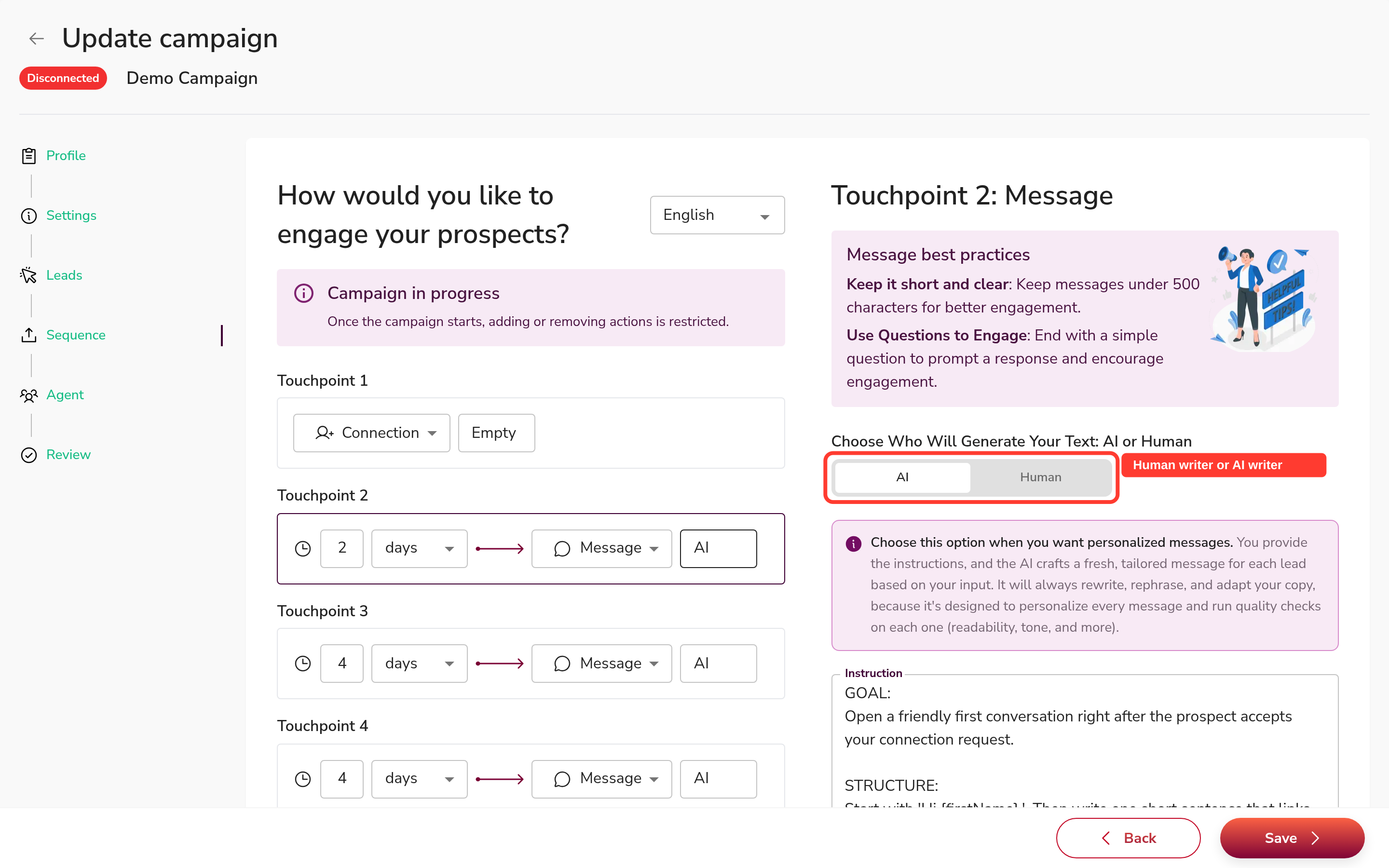
Por que {company} não está disponível no modo Human Writer?
É uma escolha de design deliberada. Um perfil do LinkedIn pode conter várias empresas ativas, uma empresa anterior, ou nenhuma empresa. No modo Human Writer, não há IA para ler o perfil em contexto e escolher a correta — portanto, uma substituição de {company} frequentemente produziria o nome errado ou deixaria um espaço em branco.
O redator IA resolve isso corretamente: lê o perfil do LinkedIn do prospecto no momento do envio e seleciona a empresa atual e relevante. Essa é a ferramenta certa quando você precisa do nome da empresa na sua mensagem.
Como envio minha mensagem exatamente como a escrevi?
O único caminho garantido para envios literais é o modo Human Writer. Ele envia seu texto palavra por palavra. Apenas {firstName}, {lastName} e {adaptive_url} (mais seus aliases) são substituídos — todo o resto é enviado exatamente como você digitou.
Se você precisa de envios literais E de um marcador que o Human Writer não suporta (como {company}), tem duas opções:
- Use o Human Writer e escreva o nome da empresa manualmente na mensagem.
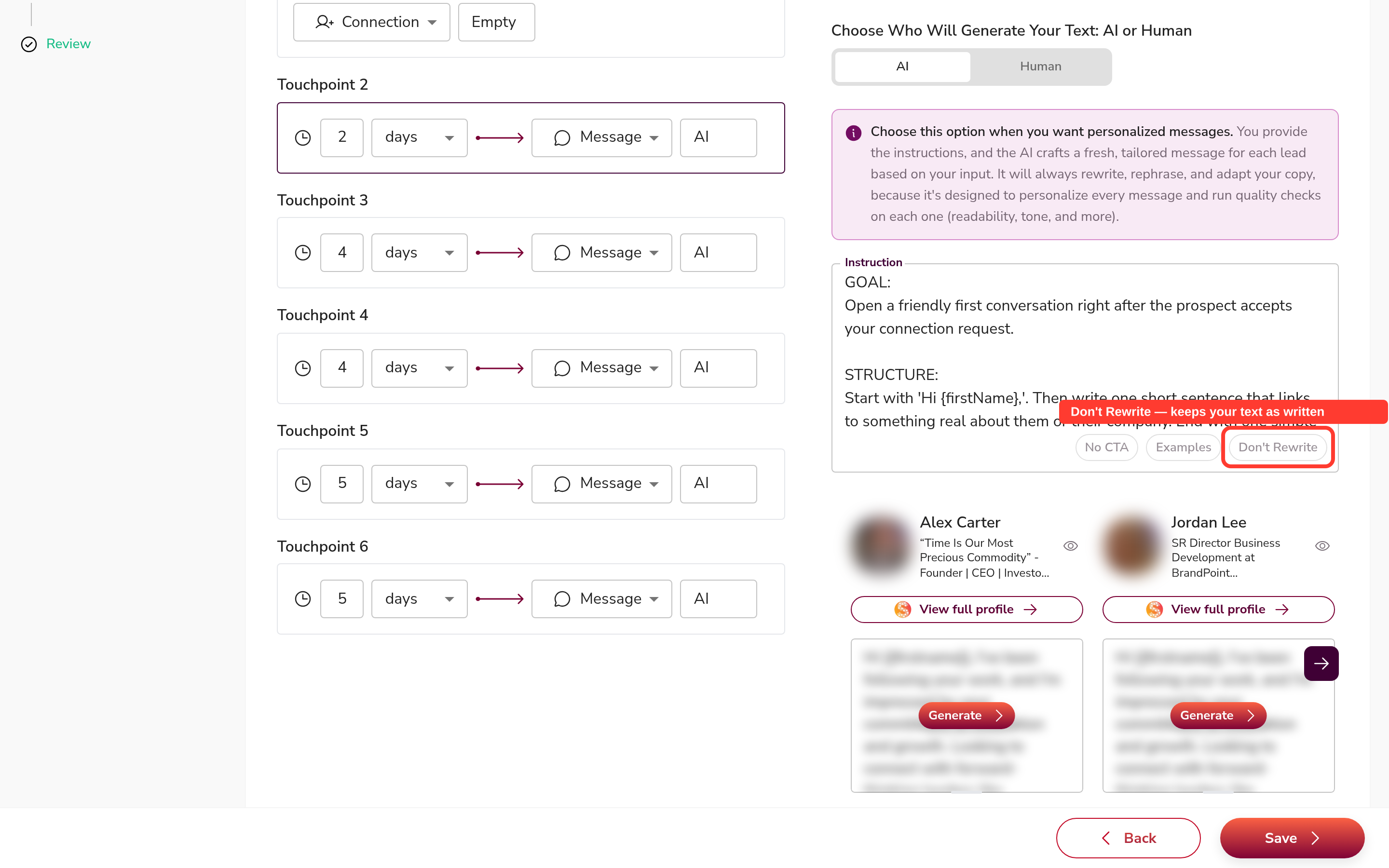
- Use o redator IA com o assistente "Não reescrever" (ou digite
Send this message without any changes:no início de sua instrução). Isso pede à IA que mantenha seu texto — mas é uma instrução forte para a IA, não uma garantia absoluta. A IA ainda pode ajustar a redação ou o comprimento.
Recomendação da equipe: use o Human Writer quando a literalidade importa. Use o redator IA + "Não reescrever" quando também precisar de {company} ou personalização por colunas, mas sempre gere uma prévia primeiro e verifique o resultado antes de lançar.
Dica: O botão "Não reescrever" no editor de instruções insere o mesmo prefixo
Send this message without any changes:que digitá-lo manualmente. Não há diferença adicional de aplicação entre os dois.
Usar colunas de planilha como marcadores
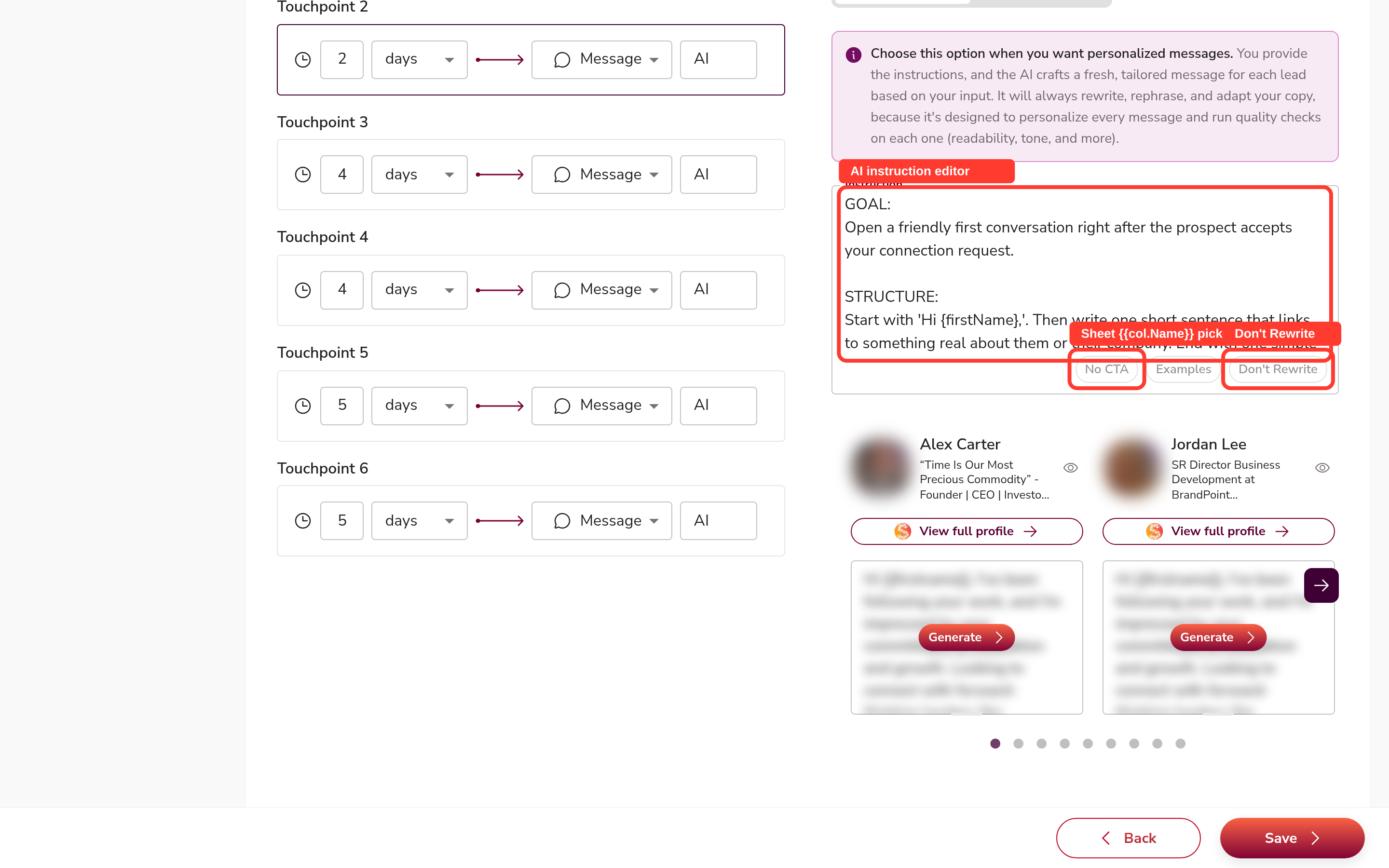
Se você importou uma planilha do Google para sua campanha, o editor de instruções IA mostra um seletor de colunas. Selecione uma coluna para inserir {{col.NomeColuna}} em sua instrução. O sistema substitui o valor de cada lead dessa coluna no momento do envio. Se o nome da coluna não corresponder, o token é impresso como texto literal.
Os tokens de coluna de planilha estão disponíveis no editor de instruções IA. Não use tokens {{col.*}} em mensagens do modo Human Writer.
O que acontece quando um marcador não pode ser resolvido?
Um marcador não resolvido é tratado como uma falha de qualidade e a mensagem não é enviada. Isso significa que um prospecto nunca recebe Hi {firstName}. As verificações de qualidade são executadas antes de cada envio e detectam marcadores com falha automaticamente.
FAQ
Por que {company} não funciona na minha mensagem Human, mesmo que eu tenha tentado {company}, {{company}}, {companyName} e {company_name}?
{company} não está disponível no modo Human Writer por design. Um perfil do LinkedIn pode ter várias empresas ativas ou nenhuma, portanto o sistema não consegue selecionar de forma confiável a correta sem contexto de IA. Use o modo redator IA — ele lê o perfil de cada prospecto e seleciona automaticamente a empresa correta.
Como envio minha mensagem exatamente como a escrevi, sem que a IA a reescreva ou encurte?
O único caminho garantido para envios literais é o modo Human Writer. Ele envia seu texto palavra por palavra. Se você usar o redator IA com "Não reescrever" (ou o prefixo Send this message without any changes:), a IA tentará manter seu texto — mas pode ainda ajustar a redação. Para envios literais estritos, escolha o Human Writer.
Na prévia da mensagem, {company} ainda aparece como texto literal — é um bug?
Não, é por design. A prévia é executada antes que os dados reais do prospecto sejam carregados, portanto não há empresa para substituir. {firstName} pode aparecer na prévia porque a interface substitui um nome de exemplo para exibição. {company} não tem valor de exemplo equivalente no modo Human.
Disse ao redator IA para "não reescrever" com instruções explícitas, mas ele ainda reescreveu minha mensagem. Por quê?
A instrução "Não reescrever" é uma sugestão forte para a IA, não uma garantia absoluta. O redator IA é projetado para personalizar cada mensagem e pode ainda ajustar a redação ou o comprimento. Se a mensagem precisar ser enviada exatamente como foi escrita, mude para o modo Human Writer.
Meu passo de campanha está definido como "Gerar por IA" — isso significa que meu texto sempre será reescrito?
Sim. "Gerar por IA" significa que o redator IA está ativo e personalizará sua mensagem para cada prospecto. Se quiser que seu texto seja enviado como foi escrito, configure o passo para o modo Human Writer.